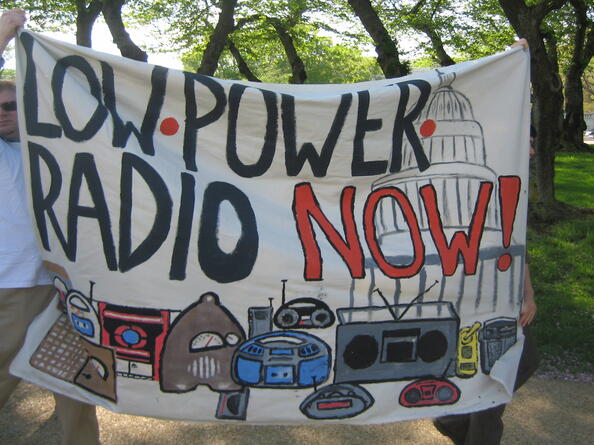
Prometheus is coordinating a nationwide effort to get City Councils to pass resolutions in support of expanded low-power radio access. Check out our City Council Resolution Toolkit for a guide on how to pass a resolution in your city or town.
Get involved with the campaign!
If you'd like to receive email 'Action Alerts from the Expand Low Power FM Radio Campaign, write to
This e-mail address is being protected from spam bots, you need JavaScript enabled to view it
If you just have a minute, email your representatives and ask them to co-sponsor the Local Community
Radio Act--which will make room for hundreds, if not thousands, more
local radio stations, even in our biggest cities!
Prometheus is going all out to make sure that the new administration finishes up the unfinished business with LPFM in the early months of the new government. There are a few awesome mechanisms right now to get the word out about our support for low power radio in the new administration and Congress.
Our coalition has met with the transition team for the new FCC and they have encouraged us to submit ideas through these websites and make sure supporters make themselves heard as first priorities are established.
So here is a really good site where you can vote for good ideas like LPFM, and there will be more to come in the coming days!
The FCC is currently considering a petition for a tenfold power increase for the new digital signals of full power radio stations. This could cause a lot of trouble for the regular analog signals that we all listen to. Click here to see what we told the FCC about this.
Now branded as HD Radio, In-Band-On-Channel (IBOC) technology has been proven to produce poor coverage and even interference to existing analog signals. Though the technology was adopted on the basis that a digital signal can provide more coverage with less power, in practice many digital signals are in fact covering less than the old analog signals did. But now that IBOC has been deemed the sole digital radio technology, what’s their solution when it doesn’t work?... Give it more power!
A coalition of the biggest HD radio broadcasters and manufacturers has recently petitioned the FCC to permit an additional 10 fold power increase in digital operation power, citing a study by IBiquity Corporation. However, an NPR led study showed such an increase could cause interference to existing analog stations. Low power community stations could be left especially vulnerable. The irony is that the same broadcasters who fought the creation of analog Low-power FM (LPFM) stations on the bogus basis of cross-channel interference, are now advocating a power increase that would create vastly more interference than LPFMs ever could have.
Fighting media consolidation one radio station at a time.
Imagine turning on the radio and hearing news about your neighborhood, or local music, or information about local issues. Now imagine building your own transmitter, broadcasting over the local airwaves information on local politics, interviews with activists and artists, or playing your favorite local music. Sound good? Welcome to the world of low-power radio, a growing national movement of people-powered broadcasting.
The
Prometheus Radio Project Recognized For Their National Work To Expand
Community Media And Fight Media Consolidation
On
September 25th, 2008 organizers from Philadelphia’s Prometheus
Radio Project accepted the prestigious Parker Award. Prometheus was recognized at the 26th Annual Everett C. Parker Ethics in
Telecommunications Lecture in Washington, DC, sponsored by Office of
Communication of the United Church of Christ and the
Telecommunications Research and Action Center (TRAC). With this honor, Prometheus was applauded for its ferocious campaigns to help
communities across the US seize the power of the airwaves by winning
broadcast licenses and building and operating their own participatory
Low Power FM radio stations.
Frequency change, streaming loom as big changes for small station
Davis Media Access (DMA) announced today that its 18-month battle to
keep low-power radio station KDRT on the air had come to a "mostly
satisfactory” conclusion.
It's been eight years since community groups have had a chance to find a place on the air through low power FM, and that's eight years too long. There's legislation to solve this, and give more places on the air for these stations. But time is running out, and we need your help!
Boston, Massachusetts has been abuzz with the story of Touch FM, an unlicensed and internet community radio station serving the African-American community of downtown Boston. When the last black-owned radio station in Boston was purchased by a big media company (a process mentioned in this earlier article from the Globe last year) community leaders got together to start Touch FM, to promote a positive, local message of community growth and pride in Boston's black neighborhoods.
Now, as the station faces major fines for broadcasting without a license, they are fighting for low power FM to be expanded to Boston and beyond with the passage of the Local Community Radio Act, House Bill 2802, Senate Bill 1675. You can tell your legislators to cosponsor these vital bills -- to bring community radio to Boston and beyond!
Prometheus
Radio Project, working closely with Media Access Project, Common
Frequency and students from Penn State, University of Colorado,
University of Pennsylvania, and Temple, have released a set of comments
and report designed to move the debate forward on the future of LPFM.